 Ultimate guide
Hiring Professional Landscape Lighting Installers: A Guide
Last Updated: November 7, 2026
Quick Summary
Hire landscape lighting installers who itemize every quote by fixture make and model, cable gauge and run length, transformer capacity, and controls, then verify insurance and licensing before signing. Compare at least two bids built on the same structure. Projects touching your main electrical service or requiring permits should go to a licensed professional.
- Ask for make and model on every fixture line so bids compare on equal hardware.
- Undersized cable causes voltage drop, leaving distant fixtures dim and prone to early failure.
- Size the transformer with headroom, since upgrading later means paying for it twice.
- Request a certificate of insurance naming you as certificate holder.
- Confirm whether the warranty covers labor as well as fixtures.
Table of Contents
- What Professional Landscape Lighting Installers Actually Do
- Outdoor Lighting Installation Cost: What Drives the Price
- Low-Voltage Landscape Lighting Systems and Why They Matter
- How to Evaluate Landscape Lighting Contractors
- Landscape Lighting Design: What a Good Plan Includes
- DIY Versus Professional Installation: Where the Line Falls
- Booking Your Free Estimate With Integrity Home Technologies
- Frequently Asked Questions
Hiring professional landscape lighting installers is one of those decisions that looks simple until the first bill arrives or the first transformer fails. The homeowners who get the best results tend to ask the same few questions before signing anything. This guide walks through what installers actually do, what drives the price, how to evaluate a contractor, and where a DIY project makes sense and where it does not.
What Professional Landscape Lighting Installers Actually Do
A professional landscape lighting installer designs, wires, mounts, and tests an outdoor lighting system so that it performs safely and looks deliberate after dark. Most residential systems run on low voltage, so the installer's work covers the transformer, the low-voltage cable run, the fixtures, and the controls that switch the system on and off.
In practice, the work starts well before anything is installed. A good installer walks the property, notes where people walk and gather, and identifies the features worth highlighting, such as trees, stone walls, or architectural details. Only then does the wiring plan take shape.
Outdoor Lighting Installation Cost: What Drives the Price
Most landscape lighting quotes are built from a handful of inputs, and understanding them lets you sanity-check any bid before you sign. The biggest driver is fixture count and fixture grade. Fixture choice has a large effect on the total cost of a residential project, so ask for the fixture make and model on every line. Ask for the fixture make and model on every line so you can compare bids on equal hardware rather than on a lump sum.
The second driver is wire run length and site conditions. Long runs from the transformer to distant beds require heavier gauge cable to limit voltage drop, and voltage drop is the quiet killer of low-voltage systems, fixtures at the end of an undersized run glow dim and fail early. Trenching through lawn is one cost; cutting and restoring concrete, pavers, or established planting is another. A quote that assumes easy trenching and then discovers hardscape mid-job is where budgets blow up, so have the installer walk the actual route and state restoration responsibilities in writing.
Labor and controls round out the picture. A simple transformer with a mechanical timer is inexpensive; a multi-zone smart controller with app scheduling adds cost but pays back in control and energy management. Permits, if your jurisdiction requires them for the scope, add a line item and time.
A practical way to read a bid is to ask for four numbers: fixture count and unit price, total cable length and gauge, labor hours, and the controls package. A common pattern is that a lower bid may achieve its price by using thinner cable, fewer zones, or a smaller transformer with no headroom for expansion. Watch out: a transformer sized to the exact current load leaves no capacity to add fixtures later, and upgrading it means paying for the transformer twice.
Because every yard differs, you should see itemized figures before committing. Request a written, line-item estimate that separates fixtures, cable, transformer and controls, labor, and any permit or restoration costs, and compare at least two bids on that same structure.
The article breaks down the main inputs behind a landscape lighting quote, which makes bids easier to compare.
| Cost driver | What to check | Why it matters |
|---|---|---|
| Fixture count and grade | Make and model on every line | Compare bids on equal hardware |
| Wire run length | Cable gauge and total length | Long runs need heavier cable |
| Site conditions | Trenching versus hardscape | Hardscape cutting can blow budgets |
| Labor | Hours on the quote | Shows what is actually included |
| Controls | Simple timer versus smart controller | Adds cost but improves control |
| Permits | Whether the scope requires one | Adds a line item and time |
Low-Voltage Landscape Lighting Systems and Why They Matter
Low-voltage systems typically step household current down to a safer level before it reaches the fixtures. Low-voltage landscape lighting installations are generally expected to follow the applicable electrical code requirements for transformer placement, wire gauge, and connections. Low-voltage wiring is also easier to modify later, which matters if you add fixtures or change your landscaping.
Because the wiring is buried or routed along the yard, poor workmanship shows up as failing fixtures, flickering, or water damage at connections. This is the main reason the installation method matters as much as the fixture choice.
How to Evaluate Landscape Lighting Contractors
Treat vetting as a short, structured process rather than a vibe check. Start with scope: does the contractor primarily do residential landscape lighting, or is outdoor lighting a side offering behind irrigation, security, or general electrical work? Ask how many residential lighting systems they installed in the past year and request two or three recent references you can actually call.
Next, verify credentials and coverage. Confirm the company carries general liability insurance and, where required, workers' compensation, and ask for a certificate of insurance naming you as certificate holder so you are notified if coverage lapses. Ask whether the crew doing the work is employees or subcontractors, because that affects who stands behind the labor. For any scope that touches line voltage or requires a permit, confirm the license your jurisdiction requires for that electrical work.
Then pressure-test the proposal. A strong bid states fixture make and model, cable gauge and total length, transformer size and capacity headroom, control method, trenching and restoration responsibilities, timeline, payment schedule, and warranty terms for fixtures, wiring, and labor separately. A weak bid is a lump sum with vague language. Check whether a warranty covers labor as well as fixtures, since a fixtures-only warranty may not cover reinstallation after a connection fails.
Finally, judge communication. Good contractors explain trade-offs and put commitments in writing. Vague answers about voltage drop, transformer sizing, or warranty exclusions are a signal to keep looking.
Questions to Ask During an Estimate
- What is included in this estimate, and what is explicitly excluded?
- Who will perform the installation, employees or subcontractors, and how long have they worked on residential low-voltage systems?
- What fixture make and model is quoted, and what warranty applies to each?
- What cable gauge and total run length are planned, and how did you calculate voltage drop?
- Is the transformer sized with capacity headroom for future fixtures?
- What warranty covers fixtures, wiring, and labor, and for how long?
- How will the site be restored after trenching, and who handles cleanup and haul-away?
- Do you pull permits when local rules require them, and is that cost in the bid?
- What is the payment schedule, and is any deposit held in escrow or subject to a written contract?
- How do you handle service calls and repairs after installation?
Permits, Electrical Safety, and Insurance
Permit requirements vary by city and county, so confirm with your local building department before work begins. Electrical safety depends on proper grounding, correctly rated components, and cable routed to the correct depth for your soil and climate. Ask for proof of liability insurance and confirm it covers the crew on your property. Watch out: an uninsured worker injured on your property can create a liability problem for you, not just for the contractor. Put the scope, price, timeline, and warranty in a written contract before any work starts, and keep a copy of the certificate of insurance with it.
Landscape Lighting Design: What a Good Plan Includes
A good plan maps each fixture's location, its purpose (path, accent, security, or wash), the wire run, the transformer location, and the control method. It also considers how the lights will look from the street and from inside the house, since many homeowners mainly see their yard through a window.
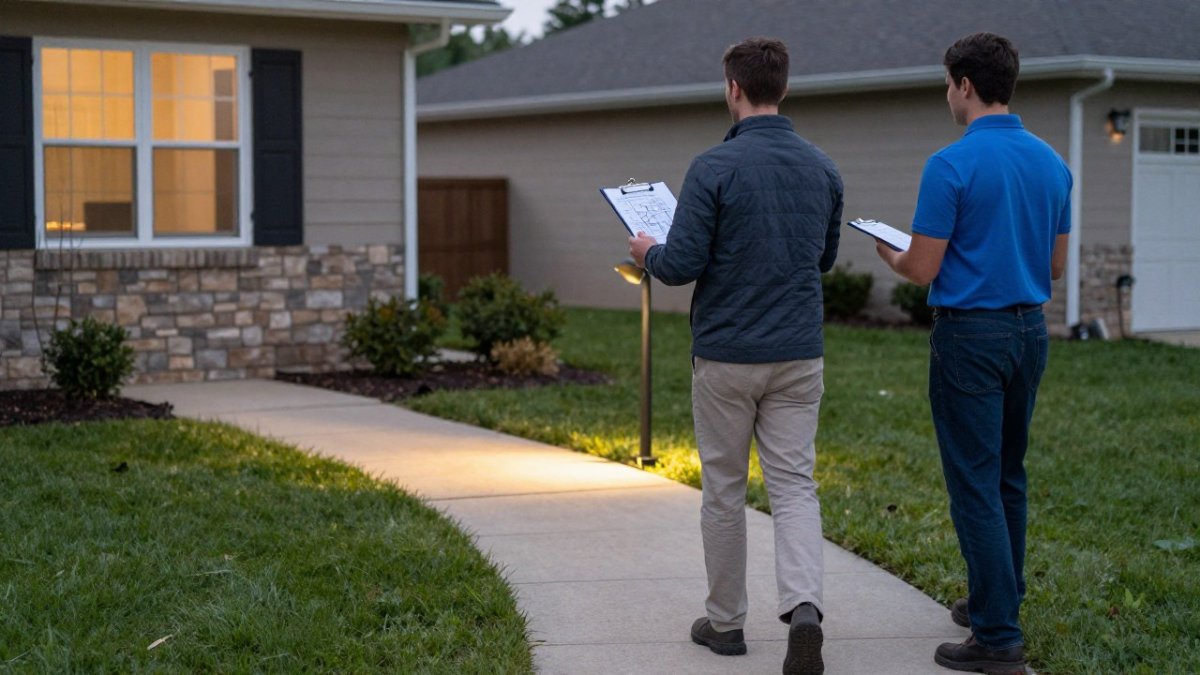
Look for a plan that balances function and atmosphere. Pathway lights should guide people safely, while accent lights should highlight a few features rather than flood the entire yard. Ask how the design will age as trees grow and shadows shift, because a well-planned layout accounts for that change.
!A homeowner and an installer walking a front yard at dusk, reviewing a lighting layout on a clipboard beside an illuminated walkway
DIY Versus Professional Installation: Where the Line Falls
Simple DIY kits can work for a small number of path lights on a short, straight run. Once a project involves line-voltage connections, long trenches, multiple zones, or integration with irrigation or smart home controls, the risk and complexity rise quickly. Mistakes in wire gauge, voltage drop, or grounding can cause dim fixtures, premature failures, or electrical hazards.
A practical rule: if the project touches your home's main electrical service or requires permits, hire a licensed professional. For a side-by-side look at the professional-versus-DIY decision for a related home system, see professional versus DIY smart home security. For a handful of plug-in or solar fixtures, a DIY approach is usually reasonable.
Booking Your Free Estimate With Integrity Home Technologies
Integrity Home Technologies offers a free estimate, which is a no-cost assessment of your project needs. Because the company is locally owned, you can ask the team questions about your project. Request your free estimate to see a detailed, itemized plan before you commit to anything.
Frequently Asked Questions
What is the average cost to install landscape lighting?
Costs depend on the number of fixtures, the length of low-voltage cable runs, the complexity of the design, and how much trenching or access work is needed, so a written estimate is the only reliable number for your yard. Integrity Home Technologies offers a free assessment of your project needs, and you can request a quote through their website to see pricing for your specific property.
Do you need an electrician to install landscape lighting?
Most residential landscape lighting runs on low-voltage power. The transformer's primary connection often falls under local electrical code. Ask any installer whether they pull permits when required and who handles the primary power connection before you sign a contract.
What should I look for when hiring a landscape lighting installer?
Look for documented installation experience, a clear written estimate, references you can contact, and a warranty on both fixtures and workmanship. Ask whether the installer carries liability and workers' compensation insurance, and whether they will handle permits. Good installers explain their design process, show completed projects, and avoid pressuring you to add fixtures you have not asked for. Integrity Home Technologies has a 5.0 rating across 41+ Google reviews and more than 20 years of installation experience.
What questions should I ask an outdoor lighting contractor?
Ask how long they have been installing landscape lighting, whether they design the layout or only install it, and what fixture brands and warranty terms they use. Ask for an itemized estimate covering fixtures, cable, transformer, labor, and any trenching. Ask how they handle power connections, permits, and damage to sprinklers or irrigation during digging. Finally, ask how service calls work after installation and what a typical repair costs.
How long does professional landscape lighting installation take?
A typical residential project can take one to several days, depending on the number of fixtures, the amount of trenching, and whether the design is completed before installation begins. Larger properties or projects needing new electrical circuits take longer. Ask the installer for a timeline in your written estimate so you know when the work starts and finishes.