 Ultimate guide
Why Professional Low Voltage Wiring Matters in 2026
Table of Contents
- What Low Voltage Wiring Actually Covers
- Low Voltage Wiring vs Traditional Electrical Wiring
- NEC Code for Low Voltage Wiring: What Homeowners Need to Know
- Benefits of Structured Cabling for Your Home Network
- DIY vs Professional Installation: The Risks You Avoid
- Troubleshooting and Maintenance: Why Installation Quality Determines Longevity
- Frequently Asked Questions
Last Updated: October 2, 2026
What Low Voltage Wiring Actually Covers
Low voltage wiring is the cabling infrastructure that carries signals rather than serious power, typically under 50 volts, and it is the backbone of every connected system in a modern home. This guide from Integrity Home Technologies explains why its quality decides whether your smart home works reliably or fights you for years.
Common Systems That Rely on Low Voltage
A surprising number of household systems depend on low voltage cabling:
- Security cameras and access control
- Whole-home audio and home theater
- Data networks, routers, and wireless access points
- Smart thermostats and HVAC integration
- Landscape, deck, and holiday lighting controls
- Intercom and doorbell systems
The Real Difference Between Low Voltage and Line Voltage
Line voltage powers outlets, appliances, and lighting circuits at 120 or 240 volts. It can injure or kill you, so it falls under strict electrical codes and licensed electricians.
Low Voltage Wiring vs Traditional Electrical Wiring
The two systems are not interchangeable. Traditional electrical wiring delivers power; low voltage wiring delivers data and control signals.
| Factor | Low Voltage Wiring | Traditional Electrical Wiring |
|---|---|---|
| Primary purpose | Data, signal, control | Power delivery |
| Typical voltage | Under 50 volts | 120/240 volts |
| Licensing | Varies by state and scope | Licensed electrician required |
| Cable types | Ethernet, coax, fiber | Romex, conduit |
| Failure mode | Signal loss, downtime | Shock, fire hazard |
| Inspection focus | Performance and code separation | Safety and load capacity |
NEC Code for Low Voltage Wiring: What Homeowners Need to Know
The National Electrical Code (NEC), published by the National Fire Protection Association and updated every three years, is the model code adopted in some form by every state and most local jurisdictions. It governs how low voltage wiring is installed, protected, and separated from power circuits. Homeowners need not memorize it, but should understand the rules that decide whether a job passes inspection.
The Article 725 Framework: Class 2 and Class 3 Circuits
Most residential low voltage wiring falls under Article 725, which divides signal circuits into two classes by energy level:
- Class 2 circuits are limited to low power levels, the intent is that a fault cannot deliver a dangerous shock or start a fire. Thermostats, doorbells, irrigation controls, and most sensor wiring sit here.
- Class 3 circuits allow somewhat higher energy for signals that travel farther or drive more load. Some access control and audio distribution runs fall into this class.
Cable Ratings: Plenum, Riser, and General Purpose
This is where most DIY and cut-rate installs get caught. Cable jacket ratings are dictated by where the cable runs:
- Plenum-rated (CMP) cable is required in plenum spaces, the air-handling cavities above a drop ceiling or below a raised floor used to circulate conditioned air. Because a fire there can spread smoke through the whole building, plenum cable uses a low-smoke, low-flame-spread jacket. It is the most expensive option and the one most often skipped to save money.
- Riser-rated (CMR) cable is for vertical runs between floors in a shaft not used for air handling. It resists flame spread up the riser but does not meet plenum smoke requirements.
- General-purpose (CM or CMG) cable is for ordinary in-wall and exposed runs where neither plenum nor riser conditions apply.
Separation From Power Conductors
Low voltage cabling generally cannot share a raceway, conduit, or box with line voltage conductors unless both are listed for the combination. Two reasons: electromagnetic interference from power conductors degrades signal quality, and a fault in the power circuit can energize the low voltage side.
Fire-Blocking and Penetrations
Every hole drilled through a fire-rated assembly, a top plate, a rated wall, a floor-ceiling assembly, must be sealed with approved fire-blocking material. Unsealed penetrations defeat the rated assembly and are a frequent finding in inspections and insurance claims.
Why This Matters Even When No Permit Is Pulled
A common mistake is assuming low voltage work is "unregulated" because the shock risk is low. It is not. Even where no permit is required, the installation must meet code, and three parties will eventually care:
- Inspectors, if any part of the project touches a permitted scope.
- Insurers, who can reduce or deny a claim if a fire is traced to non-compliant wiring.
- Future buyers, whose home inspector will note unrated cable in plenum space or unsealed penetrations.
Benefits of Structured Cabling for Your Home Network
Structured cabling is a standardized approach to running voice, data, and video cabling through one organized system, the difference between a network that scales and one that constantly needs patching.
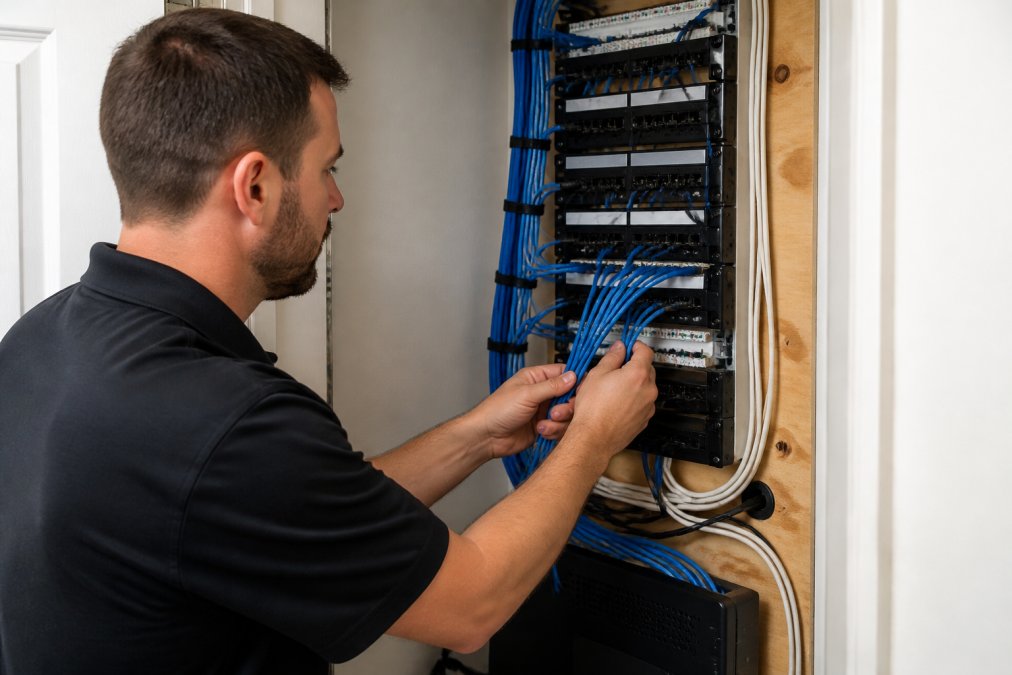
The benefits are easy to underestimate:
- Consistent throughput across every room instead of dead zones
- Lower latency for video calls, gaming, and streaming
- Easier troubleshooting because every run is labeled and documented
- Simple future upgrades without tearing into walls
- Better resale value and cleaner appearance
DIY vs Professional Installation: The Risks You Avoid
DIY low voltage wiring looks simple on video. In practice, the failure points are invisible until they cause problems, and the consequences go well beyond a dropped camera feed. For homeowners and especially business owners, the real risk is the liability of an installation never done to standard.
The Technical Failure Modes
What typically goes wrong:
- Cables run too close to power lines, causing interference that shows up as intermittent drops and slow throughput
- Sharp bends and staples crush the cable and degrade signal, Category cable has a minimum bend radius, and a staple gun ignores it
- Improper connectors cause intermittent drops that are maddening to diagnose because they pass a basic continuity test
- No labeling, making every future repair a full-day investigation
- Fire-blocking and plenum requirements missed entirely, the failure that creates a safety and code problem
Each is cheap to prevent at install time and expensive to fix later. Fixing a bad DIY job usually costs more than doing it right the first time.
The Liability and Insurance Angle Most Guides Skip
This part rarely makes it into DIY tutorials, and it matters most to anyone running a business out of the space.
What a Professional Actually Does Differently
The difference is not just skill. It is process:
- Confirms whether the space is a plenum and selects cable ratings accordingly
- Pulls the correct permits where required and coordinates with the general contractor on a remodel
- Maintains separation from power runs and crosses at right angles when crossing is unavoidable
- Seals every fire-rated penetration with approved material
- Labels and documents every run so the next technician, or owner, can work on it
- Provides a written scope and, where applicable, a workmanship warranty
At Integrity Home Technologies, we assess the project at no cost before recommending anything, so you know exactly what is needed and what is not. With over 20 years of installation experience, our locally owned team has seen what happens when this work is done poorly, and it is rarely worth the savings.
Troubleshooting and Maintenance: Why Installation Quality Determines Longevity
Most low voltage problems trace back to installation quality, not equipment failure. A camera that drops offline weekly is usually a bad connection, not a bad camera.
Common symptoms and their real causes:
| Symptom | Likely Cause | Fix |
|---|---|---|
| Intermittent camera drops | Loose or corroded connector | Re-terminate and test |
| Slow Wi-Fi in one room | Poor access point placement | Relocate or add a drop |
| Audio hum | Ground loop or cable interference | Separate signal and power runs |
| Network slowdowns | Crushed or kinked cable | Replace the run |
| Dead port | Bad punch-down at panel | Re-punch and certify |
Frequently Asked Questions
Why do electricians often avoid low voltage work?
Low voltage wiring requires different skills and tools than traditional electrical work. Most electricians are trained for line voltage systems and may not have experience with structured cabling, network termination, or the specific NEC code requirements for low voltage installations. This specialization gap means homeowners often get better results hiring technicians who focus exclusively on low voltage systems rather than general electricians who treat it as a side service.
What are the risks of DIY low voltage wiring?
DIY low voltage projects carry several risks. Without proper training, you may violate NEC code requirements for cable routing, plenum-rated materials, and fire safety. Poor terminations cause signal integrity issues, latency, and system downtime that are hard to diagnose. You also risk voiding equipment warranties and creating a system that cannot scale. Professional installation ensures code compliance, proper cable management, and reliable performance that lasts.
How does professional low voltage wiring improve network performance?
Professional installation uses structured cabling practices that maintain signal integrity across every connection. Proper cable routing avoids interference from electrical lines, correct termination prevents data loss, and organized cable management makes troubleshooting faster. The result is lower latency, higher throughput, and consistent bandwidth to every device. These gains matter most in larger homes where Wi-Fi alone cannot reach every corner reliably.
Are low voltage technicians considered licensed electricians?
Low voltage technicians are not typically licensed electricians, and in most states they are not required to be. However, they specialize in systems that electricians often do not handle: data networks, security cameras, access control, audio distribution, and automation wiring. The NEC still applies to their work, particularly for fire safety and cable installation standards. Hiring a dedicated low voltage professional ensures your system meets code without the markup of a general electrical contractor.