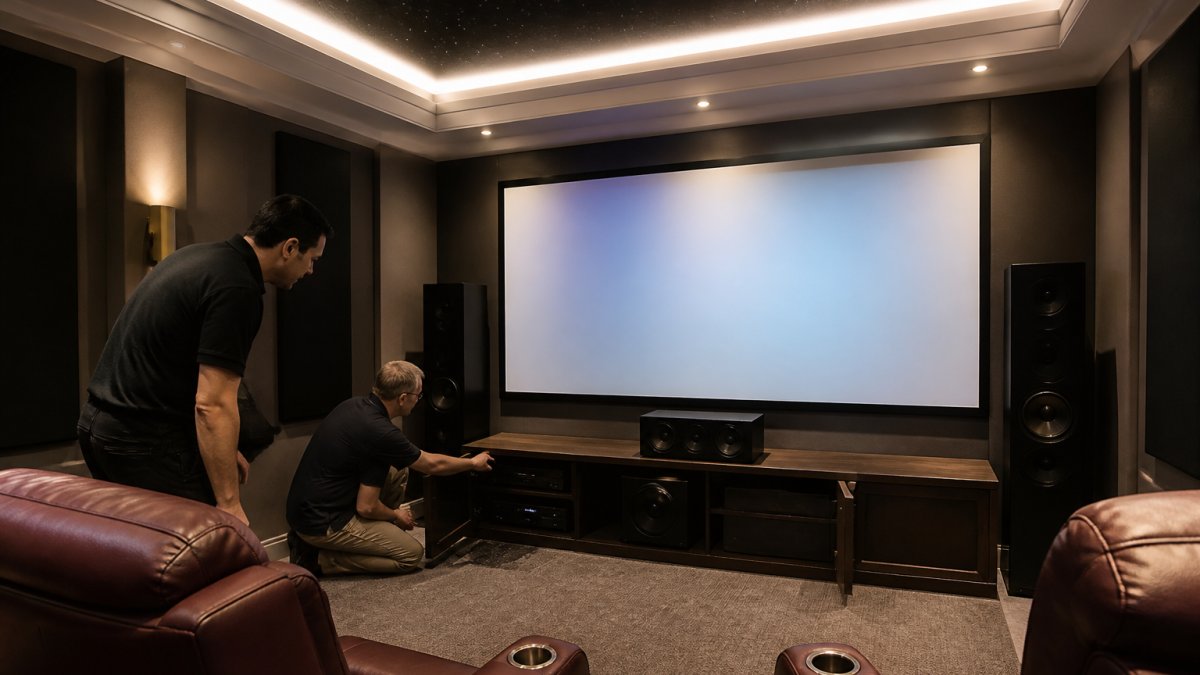
 ultimate-guide
Cost of Professional Home Theater Setup: 2026 Guide
Table of Contents
- What Drives the Cost of Professional Home Theater Setup
- Equipment Costs: Projectors, AV Receivers, and Surround Sound Systems
- Home Theater Acoustic Treatment Cost and Soundproofing
- Home Theater Installation Labor Rates and Professional Calibration
- Professional AV Calibration Services and Ongoing Maintenance
- Hidden Costs: Smart Home Integration, Wiring, and Infrastructure
- DIY vs. Professional Installation: What You're Actually Paying For
- Frequently Asked Questions
Last Updated: September 28, 2026
What Drives the Cost of Professional Home Theater Setup
Building a dedicated home theater isn't just about buying equipment and plugging it in. The true cost of professional home theater setup spans far more than the sticker price of a projector or receiver. It includes installation expertise, acoustic engineering, calibration precision, and infrastructure that most homeowners never see but absolutely feel when they sit down to watch a film.
The difference between a DIY installation and a professional setup isn't subtle. A projector mounted at the wrong angle, speakers placed without acoustic consideration, or wiring run without proper shielding creates a mediocre experience that frustrates you every time you use it. Integrity Home Technologies has over 20 years of installation experience, helping homeowners understand where their investment actually goes, and why cutting corners on installation or calibration costs more in the long run.
At its core, the cost of professional home theater setup breaks down into five major categories: equipment selection, acoustic treatment, installation labor, calibration services, and infrastructure. Each layer compounds the others. A high-end projector demands proper screen gain and throw distance calculations. Premium surround sound requires acoustic treatment to perform correctly. Smart home integration adds complexity that untrained installers often mishandle, leaving you with systems that don't communicate properly.
The real insight most guides miss: you're not paying for equipment alone. You're paying for someone who knows how to make that equipment work together in your specific space.

Equipment Costs: Projectors, AV Receivers, and Surround Sound Systems
The equipment foundation of any professional home theater setup represents the largest single expense. A quality 4K UHD projector, a capable AV receiver, and a proper surround sound system form the core, but the range in pricing reflects dramatic differences in performance and longevity.
Projectors typically represent the largest equipment investment. Entry-level 4K projectors suitable for dedicated home theaters start at a certain price point, while mid-range models with better contrast and brightness cost considerably more. High-end projectors with advanced features like motorized lens shifting and superior color accuracy push budgets significantly higher. The key variable isn't just resolution, it's brightness (measured in lumens), contrast ratio, and how well the projector handles the throw distance your room requires.
An AV receiver serves as the command center, managing audio processing, video switching, and speaker management. Budget-conscious receivers handle basic surround sound, while mid-range models support Dolby Atmos and advanced audio processing. Premium receivers add features like room correction, network streaming, and integration with smart home systems. The receiver you choose determines whether your surround sound system performs at its potential or falls short.
Surround sound systems themselves vary wildly in approach. A basic 5.1 setup includes front left/right, a center channel, two surround speakers, and a subwoofer. Moving to 7.1 or 7.1.4 (adding height channels for Dolby Atmos) requires more speakers and more complex wiring. In-wall speakers offer aesthetic advantages but require careful placement and acoustic consideration. The subwoofer alone, critical for low-frequency performance, can range from budget models to high-end units that cost as much as some complete systems.
Professional installers like Integrity Home Technologies assess your room dimensions and listening preferences to recommend equipment that actually works together. A premium projector paired with mediocre speakers creates an imbalanced experience. Conversely, excellent speakers wasted on poor room acoustics underperform their capability.
Home Theater Acoustic Treatment Cost and Soundproofing
Acoustic treatment separates a room that sounds good from one that sounds exceptional. Most homeowners underestimate this cost because they don't understand what acoustic treatment actually does, and what it doesn't.
Soundproofing prevents sound from leaving the room (or entering from outside). Acoustic treatment controls how sound behaves within the space. You need both for a professional result, but they're different investments. Soundproofing typically involves mass and decoupling, heavy materials, isolated framing, and sealed pathways. Acoustic treatment uses absorption panels, bass traps, and diffusion to manage reflections and standing waves.
A dedicated home theater room benefits enormously from acoustic treatment. Bare walls create reflections that muddy dialogue and blur surround effects. Bass frequencies pile up in corners, creating boomy, uneven low-end response. Professional acoustic treatment addresses these issues through strategic placement of absorptive panels, bass traps in corners, and diffusion to scatter mid-range reflections.
The cost of professional AV calibration services extends beyond equipment setup into room analysis. A professional calibration technician measures the room's acoustic characteristics, identifies problem frequencies, and recommends treatment placement. Some treatment is permanent, wall-mounted panels or built-in bass traps. Other solutions are flexible, allowing adjustment as your preferences evolve.
Soundproofing costs depend heavily on your situation. A room with exterior walls requires more mass than an interior room. Existing construction costs more than building acoustic considerations into new construction. Ceiling treatment adds cost but dramatically improves results by controlling overhead reflections.
Home Theater Installation Labor Rates and Professional Calibration
Installation labor represents the second-largest cost component for professional home theater setup. This isn't a commodity service where all installers charge similarly, experience, local market conditions, and project complexity drive significant variation.
Professional installers charge for multiple skill sets simultaneously. Running low-voltage wiring requires knowledge of signal integrity, shielding, and code compliance. Mounting a projector demands precision in throw distance calculations, ceiling reinforcement, and alignment. Speaker placement involves understanding how room geometry affects frequency response. Integrating smart home automation adds another layer of expertise.
Labor rates vary by region and installer experience level. A technician with basic home theater experience costs less than one with specialized training in professional calibration and smart home integration. The difference isn't just hourly rate, it's the quality of the final result and how well systems work together months and years after installation.
Professional calibration deserves separate consideration. A technician with a calibration meter, measurement microphone, and reference knowledge can optimize your surround sound system to perform at its peak in your specific room. They measure frequency response, adjust speaker levels and distances, configure subwoofer crossover points, and fine-tune Dolby Atmos height channel performance. This service typically takes several hours and produces measurably better results than default settings.
Integrity Home Technologies offers expert assessment of project needs at no cost, part of our commitment to honest pricing. Understanding your room, your preferences, and your budget before recommending solutions prevents costly mistakes and overselling.
Professional AV Calibration Services and Ongoing Maintenance
Beyond initial installation, professional AV calibration services represent ongoing value that many homeowners overlook. A properly calibrated surround sound system performs dramatically better than one left at factory defaults.
Calibration addresses several specific issues that untrained setup cannot. Speaker level matching ensures all speakers play at equal volume from your listening position, critical for seamless surround effects.
Hidden Costs: Smart Home Integration, Wiring, and Infrastructure
Most budget estimates for home theater setup miss the infrastructure costs that separate amateur installations from professional ones. These hidden costs often exceed the equipment budget for mid-range to high-end systems.
DIY vs. Professional Installation: What You're Actually Paying For
The DIY approach appeals to budget-conscious homeowners, but understanding what professional installation actually provides clarifies whether the cost difference justifies the investment.
| Aspect | DIY Approach | Professional Installation |
|---|---|---|
| Equipment Selection | Research intensive, risk of poor fit | Expert assessment of room and needs |
| Installation Quality | Variable, often adequate | Consistent, optimized for your space |
| Calibration | Basic or nonexistent | Professional measurement and tuning |
| Problem Resolution | You troubleshoot | Professional support and warranty |
| Long-term Performance | Degrades without maintenance | Sustained through professional support |
| Time Investment | Significant learning curve | Minimal time commitment from you |
Frequently Asked Questions
How much does a professional home theater setup cost?
A professional home theater setup ranges from $5,000 to $50,000+ depending on room size, equipment quality, and installation complexity. Budget-friendly dedicated home theater systems start around $5,000-$15,000. Mid-range setups with 4K UHD projectors, quality AV receivers, and surround sound systems run $15,000-$30,000. High-end reference-grade theaters with professional calibration, acoustic treatment, and smart home automation exceed $30,000. Your actual cost depends on whether you need soundproofing, custom seating, and the labor rates in your area.
What are the primary factors influencing home theater installation costs?
Room size, equipment tier, acoustic treatment needs, and labor rates drive most costs. Larger rooms require more powerful AV receivers, longer cable runs, and more extensive acoustic treatment. Choosing 4K UHD projectors over standard options adds $2,000-$5,000. Professional soundproofing and acoustic panels can cost $3,000-$10,000. Labor rates vary by region and installer expertise. Smart home integration with lighting control and automated systems adds another $2,000-$8,000. Professional AV calibration services typically cost $500-$2,000 depending on complexity.
Are there hidden costs in professional home theater setups?
Yes. Beyond equipment and labor, budget for HVAC integration ($1,000-$3,000 for climate control in sealed rooms), power conditioning and electrical upgrades ($500-$2,000), custom wiring and cabling infrastructure ($1,500-$4,000), seating and furniture ($2,000-$8,000), and ongoing maintenance. Smart home automation adds complexity and cost if you want integrated lighting control, media room scheduling, or voice control. Many homeowners underestimate acoustic treatment costs, proper soundproofing and acoustic panels often cost $3,000-$10,000 but are essential for sound quality and neighbor relations.
How should I budget for professional AV calibration services?
Professional AV calibration services typically cost $500-$2,000 depending on equipment complexity and calibration depth. Basic calibration includes speaker level matching, distance correction, and surround sound positioning. Advanced calibration involves color grading the projector, optimizing Dolby Atmos speaker placement, and fine-tuning subwoofer integration. Investing in professional calibration ensures your expensive equipment performs at its best and often reveals issues with room acoustics that require treatment. Many installers include basic calibration in labor costs, but reference-grade calibration is an add-on.
Is it better to buy a home theater package or custom components?
Custom component selection typically delivers better long-term value than pre-packaged systems. Packages simplify buying but often lock you into mid-tier equipment that doesn't scale. Custom builds let you prioritize, investing heavily in projector and surround sound while choosing budget-friendly seating, or vice versa. You also gain flexibility for future upgrades and smart home integration. However, custom builds require more expertise and longer installation timelines. A professional installer can help you balance cost and performance for your specific room and priorities.